
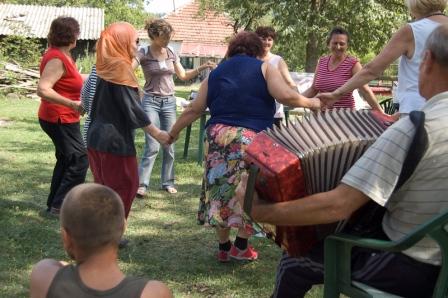
MESOLITHIC KOLO ROUND DANCE AND LABAN SYSTEM Tracing the Phenomenology of South Slavic Landscape and Body Movements inter- related to Laban Notation System By Danica Anderson Abstract The origins of the kolo, a South Slavic round dance or to be in a circle (Hubbs, 1993) are Mesolithic intangible heritage. Surviving exploitation as touristic folk dances only in modern day, the ritual round dance organizes what the past peoples observed and lived that serve the needs and interests of our present lives. The Laban system descriptive and iconic graphing of movement, a way of preserving body movements, privileges both a visual repeating encounter with the symbolic notations and that of the body movements; the conflagration of iconic movements in the kolo is, also, organized into preservation of body movements. The kolo (2005) is essentially, an ethnochoreological lived circle or round dance and a living movement practiced continually throughout the ages in its visual and body movement presentation requiring preservation and research of its lived applications. South Slavic Kolo and Knust-Laban Notation A new philology burst forth in the 1990’s with the Knust-Laban’s notation (also known as Labanotation) that was integrated into the study of the South Slavic Kolo, round dance or to be in the circle. Researchers in body movement to ethnology demanded intensive scientific methods in preserving the physical movements/dance to cultural landscapes and it found that the Laban methodology lends a fuller descriptive survey and understanding of the South Slavic kolo─ round dances properties and practices. The milieu and activities of the kolo when interleaved with Laban allows multiple reinterpretations of the living kolo monuments from the Slavic ancestors. The Laban Notation as a tool for ethnological exploration of the kolo assisted researchers of the kolo to be culturally specific, inclusive of her/historical perspective fostering an interpretive modern scholarship. The serious pioneering attempts in Serbian Ethnochoreology by two Serbian (South Slavic-formerly Yugoslavs) sisters, Danica and Ljubica Jankovic, in the 1930’s, (Jankovic, 1934, 1952) to preserve intangible heritage, commenced to document the kolo for pattern, rhythm, and melody of the steps into graphs and diagrams. Ethnochoreology is the description of ethnicity, culture or long term memorialization practices –mnemonic activities- such as daily body movements capsulated and ever evolving into the kolo with multivalent symbolic choreography. The written page can transmit only so much of the South Slavic spiritual and embodied intangible heritage commemorative meanings of the kolo but for the Jankovic sisters the body and body movements in the kolo are the written pages. The kolo is a mega-library of ethnochoreographic body movements enlisting an oral heritage tradition in two steps: 1) A careful examination of the phenomenon to be able to re-create the past with current generation’s body movements and; 2) Life experiences that is included each time the kolo is danced and manifesting a sense of place and space (Bachelard 1964). Indigenously for the Serbian Jankovic sisters in the recording, recovery and restoration of kolo folk dance movements (Jankovic, 1934, 1952) with the Labanotation application, both expressed the same immediate understanding without words the body movements and resulting rhythm. The Slavic peoples with their oral heritage practices are memories suffused with human life but the kolos were considered primitive. The preservation of ancient oral traditions most likely resulted from the astounding fact that the Serbo-Croatian language did not have an alphabet until the late 1800’s (O ‘Beirne, 1921). The Jankovic sisters argued that oral traditions easily contained all past and current body and life experiences in its static or natural state in extraordinary iconic properties in the somatic or living kolo while libraries of information and science has not preserved into the present moment past her/historical and ethnological patterns. The Laban notation system lends itself to the preservation of the kolo’s iconic and symbolic properties. The South Slavic peoples with prodigious memory abilities, orally organized; the recall of intact memories is mnemonically recalled and recreated with the body movements in the kolo and with accuracy throughout thousands of generations. However, intangible heritage such as the South Slavic oral traditions practices needed a receptacle that had keys to the esoteric meanings of the kolo. Their art of storytelling and South Slavic storied instructions is done through descriptive movement inclusive of culturally specific to landscape and peoples (Van Dyke, Alcock, 2006) as opposed to comparisons, semantics or disembodied scientific analysis. In the 1930’s the Jankovic sisters utilized auxiliary signs, diagrams and graphs to chart the round dances-kolo (Jankovic, 1934, 1952). The eight book series in Serbo-Croatian with authors unknown called Nadrodne Igre have an immediate understanding of the intangible heritage and ethnochoreology practices explored in the kolo (Bajic, 2006). The literal translation of the title Nadrodne Igre is ‘people’s play.’ Kolos are akin to Dance/Movement Therapy and strongly aligned with Laban and Bartenieff avoidance of a “mechanistic approach to movement which they considered not only inefficient but also harmful for individual’s self-image.” (Knaster, 1996) Interestingly, the accompaniment to the kolo is the South Slavic ‘Women’s songs.’ The kolo, a South Slavic intangible heritage in commemorative approaches to include music and songs immediately relate as being the same science of observing and recording both body movements and that of the landscapes in the kolos. Observing reoccurring patterns in nature, in our bodies, life experiences ultimately for the South Slavs evolved into a movement epigraphy ”memory and locality conjoin in this instance and gather force in the return to a past lived landscape…” (Van Dyke, Alcock, 2006). However, what is exclusive to the Serbian round dances-kolos, are the diverse individual leg movements-steps which is distinctive in the intangible kolo heritage capturing each unique fingerprint of the dancers both past and present (Jankovic, 1934, 1952). Capturing the unique footprints mirroring our “no two alike” fingerprints is a significant ethnochoreological endeavor in line with Mother Nature’s sense of order. Within Laban analysis the focus is, also, toward the inner energy merged with the movement behaviors that specifically points to time as sudden or sustained and space as direct or indirect (Knaster, 1996). What