
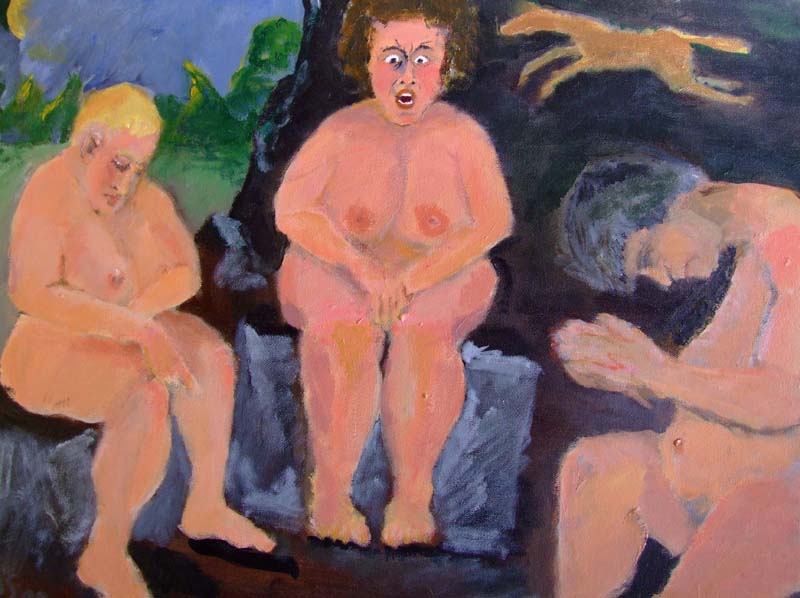
News from the Field Fall 2003 Battered by incessant wars and rapes since Bronze Age, females are in deep shock and have amnesia regarding female culture and female humanity. Imbedded from thousands of years of genocide practices, fear, generations long, has become this amnesia and female silence. 2003 was a crisscrossing of the globe. In January and February I was in Sri Lanka the exact time a peace treaty was signed declaring an end to 22 years of war. However, I have witnessed as other women have that the war never ends. In June and July, I was in Bombay/Mumbai India and back to Bosnia. In Bosnia, I facilitated the annual “Peaceful Dimensions Against Gender Violence,” conference in Novi Travnik, Bosnia. Again, I witnessed how the war never ends for women despite having multinational troops stationed in Bosnian cities for over 8 years now. Mumbai had female beggars with children so thin that I thought I was looking at sticks. My kolo (Bosnian for circle or to dance) work in these places allows females to remember their wisdom so that they become self-sustainable not only economically but also emotionally. The kolo work ennobles females to deal with their traumas by tapping into our inherent female culture and roots. Battered by incessant wars and rapes since Bronze Age, females are in deep shock and have amnesia regarding female culture and female humanity. Imbedded from thousands of years of genocide practices, fear, generations long, has become this amnesia and female silence. The Bosnian women, called ‘Sumejja Kolo,’ have been in the kolo program since March 1999 and ten of them have become certified kolo advisors. The women become empowered once the amnesia is broken. How? The Sumejja Kolo marched for garbage pickup in their town of Novi Travnik, and facilitated kolo meetings with war crimes survivors in Vittez-Amijca, Jayce, Zenica and Sebrenica. To facilitate a kolo gathering the necessary ingredients of coffee cups, coffee cup readings and other women’s divinatory arts such as the Slavic 41 white beans and first person stories are strongly present. The shock triggers memory when hearing other female’s first person story. More climatic then a massive earthquake, bearing witness to the Bosnians and in Sri Lanka first person stories one becomes conscious at how universal and how webbed we really are to each other. Tamils, Hindus, Singhalese, Bosnian Muslims, all females spoke in exact detail the same war crime the world over. The hatred of anything female is murdered, assaulted, denigrated and made invisible. At one of the kolo meetings in Bosnia, an elder white haired woman with huge reading glasses sucked up her crying to state how she just realized her mother could not show her love as she has done with her children. Wringing her tissue she declared the war never ends. Do females blame the war for not being able to love their children especially their daughters? Often the Bosnian women remark how it was better during the war then now. I always wonder with that remark if that is why we have incessant wars. Countless times, my soul inquires where are the women, the earth wide sisterhood? How is it that we as females are in denial of catastrophic rape statistics, murders and global wars declared not on countries, armies or ruling male governments but on homes (wombs archetypal), families and children? More money was spent in developing a tank that shears homes in half for the Israeli army then for humanitarian aid efforts there. Female culture and Female humanity embraces solidarity usually only in times of war, traumas and crisis. The kolo work allows for solidarity and support to occur in times of need, advocacy and concern for all sisters earth wide. If you are interested in collaborating for solidarity and to break the amnesia -female silence please consider a donation or your services for the kolo work and the nonprofit ‘The Kolo: Women’s Cross Cultural Collaboration.” The annual “Peaceful Dimensions’ Conference,” held annually in Novi Travnik, has international female visitors from other countries bearing witness to Bosnian female’s war and first person stories. Join me for that work/study tour and make a difference in your life and the earth. Become visible. Check the Baba Yaga Section of this website and read first person story accounts of the Sumejja Kolo. Your donation to them will be heartfelt. A fund towards a ‘safe place’ for females in the town of Novi Travnik is one dream. Air miles for the Bosnian certified kolo advisors and for myself to provide more training is very needed. Donations can be tax exempt through the nonprofit The Kolo: Women’s Cross Cultural Collaboration. Even $10 goes such a long way if each of us donated. Women can heal the earth and stop the war that never ends. Feminine Matrix is requesting articles from females who are advocating, bearing witness to the war that never ends. We will publish the article that proclaims and understands the depth of bearing witness, solidarity and support for female culture and female humanity.
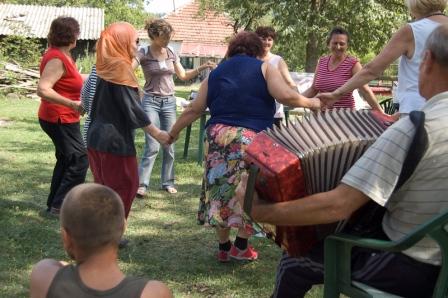
MESOLITHIC KOLO ROUND DANCE AND LABAN SYSTEM
MESOLITHIC KOLO ROUND DANCE AND LABAN SYSTEM Tracing the Phenomenology of South Slavic Landscape and Body Movements inter- related to Laban Notation System By Danica Anderson Abstract The origins of the kolo, a South Slavic round dance or to be in a circle (Hubbs, 1993) are Mesolithic intangible heritage. Surviving exploitation as touristic folk dances only in modern day, the ritual round dance organizes what the past peoples observed and lived that serve the needs and interests of our present lives. The Laban system descriptive and iconic graphing of movement, a way of preserving body movements, privileges both a visual repeating encounter with the symbolic notations and that of the body movements; the conflagration of iconic movements in the kolo is, also, organized into preservation of body movements. The kolo (2005) is essentially, an ethnochoreological lived circle or round dance and a living movement practiced continually throughout the ages in its visual and body movement presentation requiring preservation and research of its lived applications. South Slavic Kolo and Knust-Laban Notation A new philology burst forth in the 1990’s with the Knust-Laban’s notation (also known as Labanotation) that was integrated into the study of the South Slavic Kolo, round dance or to be in the circle. Researchers in body movement to ethnology demanded intensive scientific methods in preserving the physical movements/dance to cultural landscapes and it found that the Laban methodology lends a fuller descriptive survey and understanding of the South Slavic kolo─ round dances properties and practices. The milieu and activities of the kolo when interleaved with Laban allows multiple reinterpretations of the living kolo monuments from the Slavic ancestors. The Laban Notation as a tool for ethnological exploration of the kolo assisted researchers of the kolo to be culturally specific, inclusive of her/historical perspective fostering an interpretive modern scholarship. The serious pioneering attempts in Serbian Ethnochoreology by two Serbian (South Slavic-formerly Yugoslavs) sisters, Danica and Ljubica Jankovic, in the 1930’s, (Jankovic, 1934, 1952) to preserve intangible heritage, commenced to document the kolo for pattern, rhythm, and melody of the steps into graphs and diagrams. Ethnochoreology is the description of ethnicity, culture or long term memorialization practices –mnemonic activities- such as daily body movements capsulated and ever evolving into the kolo with multivalent symbolic choreography. The written page can transmit only so much of the South Slavic spiritual and embodied intangible heritage commemorative meanings of the kolo but for the Jankovic sisters the body and body movements in the kolo are the written pages. The kolo is a mega-library of ethnochoreographic body movements enlisting an oral heritage tradition in two steps: 1) A careful examination of the phenomenon to be able to re-create the past with current generation’s body movements and; 2) Life experiences that is included each time the kolo is danced and manifesting a sense of place and space (Bachelard 1964). Indigenously for the Serbian Jankovic sisters in the recording, recovery and restoration of kolo folk dance movements (Jankovic, 1934, 1952) with the Labanotation application, both expressed the same immediate understanding without words the body movements and resulting rhythm. The Slavic peoples with their oral heritage practices are memories suffused with human life but the kolos were considered primitive. The preservation of ancient oral traditions most likely resulted from the astounding fact that the Serbo-Croatian language did not have an alphabet until the late 1800’s (O ‘Beirne, 1921). The Jankovic sisters argued that oral traditions easily contained all past and current body and life experiences in its static or natural state in extraordinary iconic properties in the somatic or living kolo while libraries of information and science has not preserved into the present moment past her/historical and ethnological patterns. The Laban notation system lends itself to the preservation of the kolo’s iconic and symbolic properties. The South Slavic peoples with prodigious memory abilities, orally organized; the recall of intact memories is mnemonically recalled and recreated with the body movements in the kolo and with accuracy throughout thousands of generations. However, intangible heritage such as the South Slavic oral traditions practices needed a receptacle that had keys to the esoteric meanings of the kolo. Their art of storytelling and South Slavic storied instructions is done through descriptive movement inclusive of culturally specific to landscape and peoples (Van Dyke, Alcock, 2006) as opposed to comparisons, semantics or disembodied scientific analysis. In the 1930’s the Jankovic sisters utilized auxiliary signs, diagrams and graphs to chart the round dances-kolo (Jankovic, 1934, 1952). The eight book series in Serbo-Croatian with authors unknown called Nadrodne Igre have an immediate understanding of the intangible heritage and ethnochoreology practices explored in the kolo (Bajic, 2006). The literal translation of the title Nadrodne Igre is ‘people’s play.’ Kolos are akin to Dance/Movement Therapy and strongly aligned with Laban and Bartenieff avoidance of a “mechanistic approach to movement which they considered not only inefficient but also harmful for individual’s self-image.” (Knaster, 1996) Interestingly, the accompaniment to the kolo is the South Slavic ‘Women’s songs.’ The kolo, a South Slavic intangible heritage in commemorative approaches to include music and songs immediately relate as being the same science of observing and recording both body movements and that of the landscapes in the kolos. Observing reoccurring patterns in nature, in our bodies, life experiences ultimately for the South Slavs evolved into a movement epigraphy ”memory and locality conjoin in this instance and gather force in the return to a past lived landscape…” (Van Dyke, Alcock, 2006). However, what is exclusive to the Serbian round dances-kolos, are the diverse individual leg movements-steps which is distinctive in the intangible kolo heritage capturing each unique fingerprint of the dancers both past and present (Jankovic, 1934, 1952). Capturing the unique footprints mirroring our “no two alike” fingerprints is a significant ethnochoreological endeavor in line with Mother Nature’s sense of order. Within Laban analysis the focus is, also, toward the inner energy merged with the movement behaviors that specifically points to time as sudden or sustained and space as direct or indirect (Knaster, 1996). What
Her political activities define her radical nature
Wahu Kaara and Danica Anderson, Female Solidarity Wahu Kaara, Nobel Peace Prize Nominee/Winner 2005, board member of the Kolo: Women’s Cross Cultural Collaboration is a leading advocate for social justice in Kenya. She says: “African women are not dying for Africa anymore; they want to live for Africa.” She works for the Kenya Debt Relief Network (Kendren), the African Social Forum and the Kenya Social Forum. Her political activities define her radical nature and instead of her name or stereotyped roles females play, Wahu’s identity is the community she keeps. A 53-year-old widow, describes herself as a global social justice activist. The former history and Kiswahili teacher says she has been radical from an early age, having been involved in promoting social justice and economic democracy for 30 years. Despite the repression from the government and the hard times she experienced when her husband was forced into exile, the mother of four relentlessly worked locally and is today involved internationally in the African Social Forum and the Kenya Debt Relief Network, and she is also one of the main leaders of Katiba Watch, the main lobby group spearheading the ongoing mass mobilization in Kenya around the demand for a new constitution. We can learn more about Wahu through a series of quotes and pieces from conversations I had with her in Toronto, Canada for the Genevieve Vaughn sponsored (M) Otherworld Conference. This is Wahu’s voice and identity: All movements we do must know how to connect making what we know. Refuse to be a victim. Stand up in your power. Fertility of Women’s Spirituality Women are being dislocated and disoriented. We need to stop the unending re-inventing and re-engineering of women, who we are. The matriarchy is the heartbeat of the community. The waking up of the people…. How matriarchy is a community not a system. We have to show how it works. We get lost when we do not connect all.